The Digital Voice of Civil Society in Climate Crisis Communication – Twitter Analysis of NGOs in Turkey
Communicating the Climate Crisis: Twitter Strategies of Environmental NGOs in Turkey
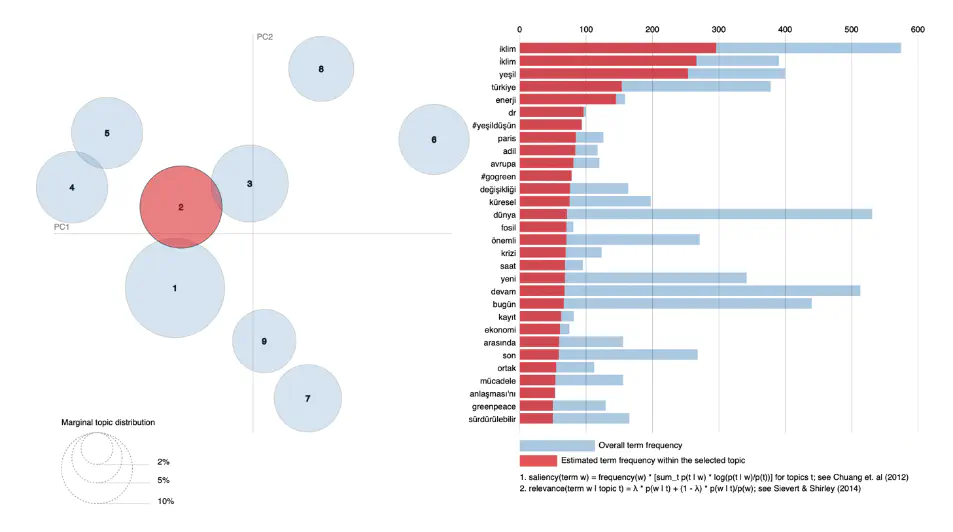 Image credit: Unsplash
Introduction
Although the climate crisis is one of the most urgent issues of our time, we still face major challenges in raising public awareness and taking action. So how are non-governmental organizations (NGOs) communicating this crisis? Through which themes do they engage with the public? The answers to these questions can be found in a comprehensive study analyzing the Twitter posts of environmental NGOs in Turkey.
Challenges of Climate Communication
Due to its complex structure, the climate crisis is a difficult topic to communicate effectively. Factors such as the broad scope of messages, geographic disparities, thematic diversity, and the ambiguity of responsibility pose major barriers to impactful communication (Table 1).
Table 1: Common Challenges in Climate Communication
| Item | Effects |
|---|---|
| Complexity of climate messages | Messages may not be fully understood or may cause confusion due to broad scope. |
| Geographic distribution and focus | Different regions experience different effects; repeated messages may seem irrelevant. |
| Thematic diversity | Topics such as CO₂, drought, transportation, energy divide the focus of messaging. |
| Responsibility attribution | Responsibility may be assumed to lie only with governments, ignoring individual action. |
| Uncertainty | The effects of climate change may not be clearly visible, fostering a “wait and see” attitude. |
| Lack of specialized reporting | There is a lack of expert journalists in the media. |
| Competing issues | The climate crisis may be overshadowed by other news such as war or sports. |
To overcome these challenges, NGOs must develop different approaches tailored to different target audiences. While politicians focus on legislation, scientists emphasize credibility, and farmers prioritize productivity (Table 2).
Table 2: Target Audiences and Their Cognitive Frames in Climate Communication
| Target Audience | Cognitive Frame |
|---|---|
| Politicians | Law and policy-oriented |
| Scientists | Scientific accuracy and solution focus |
| Government officials | Policy implementation |
| Farmers | Productivity and land use |
| Industry representatives | Sectoral impacts (logistics, production, etc.) |
| Academics | Education of students |
| General public | Diverse interests, hard to segment |
New Opportunities in the Digital Age
Social media platforms, especially Twitter, offer NGOs vital opportunities to reach large audiences and increase civic engagement. This study, which analyzed 7,764 tweets from five prominent environmental NGOs in Turkey between 2020 and 2021, sheds light on the digital dimension of climate communication.
Climate Communication Under Nine Main Themes
Using the Latent Dirichlet Allocation (LDA) method, the topic modeling analysis revealed that the NGOs’ tweets clustered around nine main themes (Table 4, Figure 3):
Table 4: LDA Topics and Example Terms
| # | Topic | Term 1 | Term 2 | Term 3 | Term 4 | Term 5 | Term 6 | Share (%) |
|---|---|---|---|---|---|---|---|---|
| 1 | Biodiversity | wildlife | protection | hunting | species | non-toxic | pesticide | 19.5 |
| 2 | Climate | crisis | energy | fossil | urgent | change | global | 13.3 |
| 3 | Sustainability | future | protect | plastic bag | nature | zero | waste | 11.7 |
| 4 | Environment | air | agriculture | health | water | clean | food | 10.2 |
| 5 | Activism | coal | thermal | plants | movement | cancel | petition | 10.1 |
| 6 | Other | thanks | support | today | continue | happy | we await | 9.8 |
| 7 | Information | do you know | if you saw | flowers | plant | tree | we prepared | 9.0 |
| 8 | Social Responsibility | volunteer | join | nature | donation | tree | educational | 8.4 |
| 9 | Mining | underneath | there is death | licensed | mines | gold | coal | 8.0 |
Figure 3: Thematic Distribution Chart (Percentage)
- Biodiversity : ████████████████ 19.5%
- Climate : ███████████ 13.3%
- Sustainability : █████████ 11.7%
- Environment : ████████ 10.2%
- Activism : ████████ 10.1%
- Other : ███████ 9.8%
- Information : ███████ 9.0%
- Social Responsibility : ██████ 8.4%
- Mining : ██████ 8.0%
1. Biodiversity (19.5%)
The most prominent theme includes issues such as wildlife protection, hunting bans, and toxin-free agriculture. NGOs emphasize the need to shift from an anthropocentric perspective.
2. Climate (13.3%)
This theme includes terms directly related to the climate crisis, such as global climate change, green energy, and the Paris Agreement.
3. Sustainability (11.7%)
Topics such as zero waste, recycling, and building green cities for future generations define this category.
4. Environment (10.2%)
This theme includes core environmental issues such as air pollution, agriculture, food safety, and water resources.
5. Activism (10.1%)
Action-oriented content like thermal power plants, coal mining, and petition campaigns make up the activism theme.
6. Miscellaneous (9.8%)
General-purpose content unrelated directly to climate or environmental issues, such as thank-you notes, celebration posts, and supportive messages. Often used to maintain engagement and goodwill with followers.
7. Informative Content (9.0%)
Educational or interactive posts aiming to raise awareness and engage followers through nature-related facts or questions. Typical content includes quizzes like “Would you recognize this flower?” or brief facts about biodiversity.
8. Social Responsibility (8.4%)
Content related to NGO-led projects that promote public participation, such as volunteering opportunities, donation campaigns, environmental education, and community outreach initiatives.
9. Mining (8.0%)
Posts focused on the negative impacts of mining operations—such as environmental degradation, worker safety concerns, and biodiversity loss. Includes strong critiques of gold and coal extraction projects.
Alignment with Behavioral Change Stages
The study shows that NGOs’ communication strategies align with Prochaska’s Stages of Change Model (Table 3). Awareness is raised through the information theme (9%), preparation is supported through social responsibility (8.4%), and transition to action is facilitated through activism.
🔄 Table 3: Communication Periods and the Behavioral Change Model
| Period | Communication Strategy | Behavior Stage |
|---|---|---|
| 1990s | Conveying the reality of climate change | Precontemplation (“There’s no problem”) |
| 2000s | Emphasizing anthropogenic effects | Contemplation (“Is this necessary?”) |
| 2010s | Including emotions and cognition | Preparation (“I want to change, but how?”) |
| 2020s | Promoting action via digital media | Action (“I’m making the change”) |
Conclusion and Recommendations
This study reveals that environmental NGOs in Turkey adopt a multidimensional approach to climate communication. The prominence of biodiversity shows that these organizations act with a broad ecological perspective.
To increase the effectiveness of climate communication, NGOs should:
- Take into account the mental frameworks of each target audience
- Develop integrated messages that leverage thematic diversity
- Use digital platforms more strategically
As one of the first comprehensive analyses in the field of climate communication in Turkey, this study provides a valuable foundation for future research. It also plays a pioneering role in adapting digital methods such as LDA to communication sciences.
To ensure that civil society’s digital voice against the climate crisis is stronger, it is essential to expand such analyses and translate their findings into practical strategies.
This content is based on the following academic article: Kemal Günay Climate Article.