Climate Communication Through Dialogic Engagement - How NGOs and Ministries Foster Public Participation on Social Media
How do NGOs and public institutions engage the public on the climate crisis? Analyzing Twitter interactions through the lens of dialogic communication
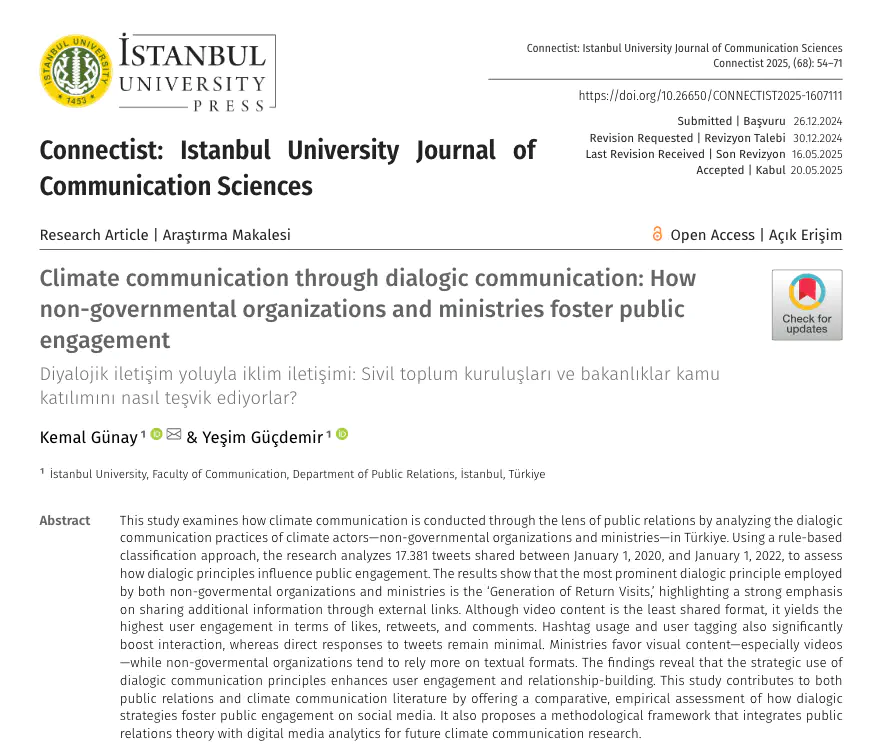 Image credit: Unsplash

Introduction: The Climate Crisis and Communication Imperative
Climate change stands as one of the most pressing global challenges of our time. However, communicating this complex, large-scale issue to the public and motivating action presents significant communication challenges. Effective communication strategies are critical for translating technical climate science into public understanding, raising awareness, and encouraging behavioral change in the fight against the climate crisis.
In my latest research article, derived from my doctoral dissertation, I examined the communication strategies of climate actors in Turkey—specifically non-governmental organizations (NGOs) and ministries—on Twitter. The study focuses on how these actors employ dialogic communication principles to foster public engagement in climate issues.
Understanding Dialogic Communication
Dialogic communication differs from one-way information transmission by emphasizing mutual interaction and understanding. This communication model, developed by Kent and Taylor (1998), advocates for building trust-based relationships between organizations and their audiences, particularly in digital media environments.
Five Core Dialogic Principles:
- Dialogic Loop: Responding meaningfully to audience questions and concerns
- Ease of Interface: Ensuring platform usability and accessibility
- Conservation of Visitors: Retaining users by avoiding disruptive elements
- Generation of Return Visits: Encouraging users to revisit through compelling content
- Usefulness of Information: Providing valuable, relevant content that meets audience needs
Research Methodology
My study analyzed 17,381 tweets shared between January 1, 2020, and January 1, 2022. I collected this data using Python programming and Twitter API v2, employing a rule-based classification approach to categorize tweet content according to dialogic principles.
Analyzed Metrics:
- Content types: Text, photos, videos
- Engagement indicators: Likes, retweets, comments
- Dialogic features: Hashtag usage, user tagging, link sharing
Key Findings
1. Most Prevalent Dialogic Principle: “Generation of Return Visits”
Both NGOs and ministries most frequently shared links to external websites where additional information could be obtained. This demonstrates a strategy of directing audiences toward deeper, more comprehensive information.
- NGOs: 83.48% share additional information sites
- Ministries: 77.96% share additional information sites
2. Content Format Preferences
Photos were the most shared content type (51.77%), but videos generated the highest engagement:
- Video content: Average 466 likes, 98.4 retweets, 30.6 comments
- Photo content: Average 341.1 likes, 82.1 retweets, 26.9 comments
- Text content: Average 139.8 likes, 29.1 retweets, 10 comments
3. NGOs vs. Ministries: Strategic Differences
NGOs:
- Rely more on text-based content and hashtags
- 40.66% hashtag usage rate
- Focus on information dissemination and awareness-raising
Ministries:
- Emphasize visual content, particularly videos
- 22.58% user tagging rate
- More frequent linking to their own websites
- Higher use of multimedia formats
4. Engagement-Driving Factors
- Hashtag usage: The highest engagement-generating factor
- User tagging: Significantly increases interaction
- Video content: Least shared but most engaging format
- Direct responses: Remained at relatively low levels
Implications for Climate Communication
1. The Power of Video Content
Videos represent the least produced but most engaging content type, suggesting that visual storytelling can more effectively communicate complex climate issues.
2. Information-Focused Approach
Both actor groups primarily focus on information sharing rather than interactive communication, indicating a preference for one-way information transmission over dialogue.
3. Digital Participation Potential
The effectiveness of hashtags and tagging in increasing engagement reveals social media’s significant potential for participatory climate communication.
4. Organizational Communication Patterns
The research reveals distinct communication strategies: NGOs excel in grassroots mobilization and awareness-raising, while ministries leverage institutional authority and multimedia resources.
Strategic Recommendations
For Climate Communicators:
- Invest in video content production to maximize engagement
- Develop comprehensive hashtag strategies for broader reach
- Increase interactive content to foster dialogue
- Implement audience segmentation for targeted messaging
- Balance information sharing with engagement opportunities
For Future Research:
- Comparative analysis across different social media platforms
- Semantic analysis and sentiment evaluation of climate content
- Long-term behavioral change impact studies
- Cross-cultural climate communication effectiveness
The Road Ahead: From Information to Transformation
This research demonstrates the critical importance of dialogic approaches in climate communication. The strategic differences between NGOs and ministries reveal that each actor type brings unique strengths to climate communication efforts. In addressing an urgent issue like the climate crisis, collaboration between these actors in developing more interactive and participatory communication strategies is essential.
Social media serves not merely as an information dissemination tool but as a powerful platform for social participation and behavioral change in climate action. To fully harness this potential, strategic application of dialogic communication principles is necessary.
Key Takeaways:
- Video content drives engagement despite being underutilized
- Dialogic principles significantly impact public participation
- Different actors require different strategies for optimal effectiveness
- Social media’s interactive features remain underexploited in climate communication
- Strategic communication planning can enhance climate action mobilization
Conclusion
The climate crisis demands not just scientific solutions but also effective communication strategies that can mobilize public action. This research provides empirical evidence that dialogic communication principles can significantly enhance public engagement with climate issues on social media platforms.
As we face the mounting challenges of climate change, the role of strategic communication becomes increasingly critical. By understanding how different climate actors can leverage dialogic principles, we can work toward more effective, engaging, and participatory climate communication that moves beyond awareness toward meaningful action.
The future of climate communication lies not in the volume of information shared, but in the quality of engagement fostered. Through dialogic approaches, we can transform climate communication from a one-way broadcast into a dynamic, participatory process that empowers individuals and communities to become active participants in climate solutions.
This blog post is derived from my research article “Climate communication through dialogic communication: How non-governmental organizations and ministries foster public engagement” published in Connectist: Istanbul University Journal of Communication Sciences.
Source Article: Günay, K. & Güçdemir, Y. (2025). Climate communication through dialogic communication: How non-governmental organizations and ministries foster public engagement. Connectist: Istanbul University Journal of Communication Sciences, (68), 54-71.
Related Work: